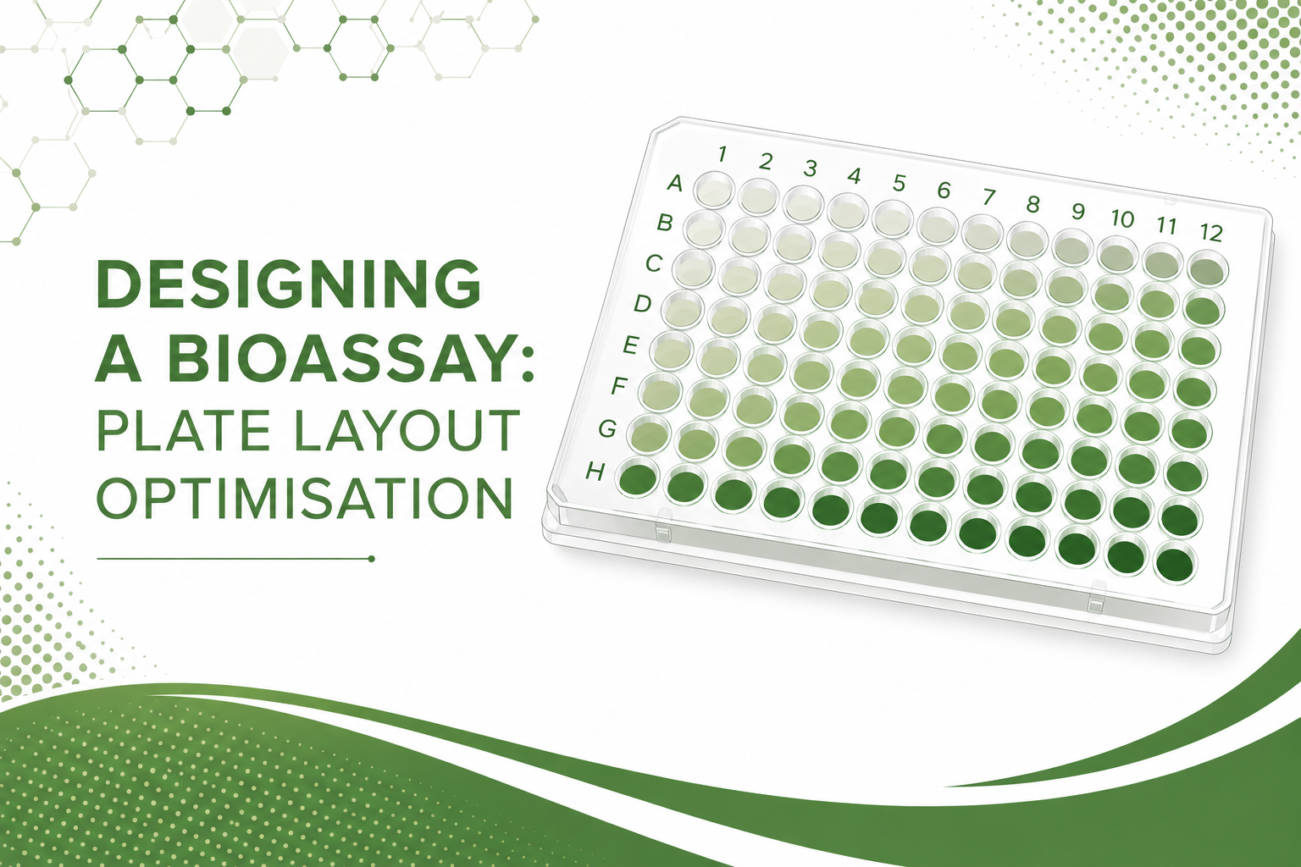

Statistics for Bioassay Validation
Quantics can help ensure that your bioassay validation study follows the appropriate regulatory guidance in all its statistical aspects, including both design and analysis.
Our expert team of world-leading statisticians are well-equipped to assist with the design and analysis of any bioassay validation study. We can help you determine critical bioassay validation parameters including:
Relative Bias (Accuracy)
Intermediate Precision (Precision)
Assay Range
Specificity
Dilutional Linearity
Robustness
We know that bioassay validation can be complicated, which is why we pride ourselves on clear and regular communication with our clients, both to determine client needs and to discuss results and next steps.

Bioassay validation is the process of demonstrating and documenting that the performance characteristics of the procedure and its underlying method meet the requirements for the intended application and that the assay is thereby suitable for its intended use. For bioassays, USP general chapter Biological Assay Validation <1033> and ICH Q2(R1) should be followed
Get In Touch
Our Blog
Our blogs cover everything you want to know about biostatistics, from the intricacies of bioassay optimisation to the details of sample size calculations. Subscribe to make sure you never miss a thing.