

Statistics for ELISA Development
Involving appropriate statistical support from the early stages of ELISA development can help to ensure a linear development pathway by optimising the experimental designs and thus minimising repeated work. Mathematical simulation can replace the need for some laboratory work altogether. This combination can save considerable time and expense throughout your product development life cycle.
The Bursa-Yellowlees Method
The Bursa-Yellowlees (BY) method is an innovative alternative to traditional ELISA analysis techniques. By making efficient use of every single data point, QuBAS can provide superior accuracy and precision for many ELISA methods.
BY method is inspired by relative potency calculations. Assuming we have similarity between a test sample and the standard, we know that any test sample is a dilution of standard. The concentration of the standard is known, meaning we can determine the concentration of the test sample by comparing its response in the assay to that of the reference.
This is precisely what the BY Method does. If a test sample is less concentrated than the standard, then it’s response cure will be shifted to the right relative to the standard curve. Conversely, if the test sample is more concentrated than the standard, then its response curve will be shifted to the left. In both cases, the difference in concentration is encoded into the horizontal shift, which is then used to calculate the overall concentration of the test sample.
Improved Accuracy and Precision
Traditional ELISA analysis includes only test sample responses within the standard range, leading to arbitrary cut-offs which can reduce precision and introduce potential biases in reportable results. The BY method, by contrast, uses always uses all available responses, providing superior accuracy and precision in many cases.
Reduced Assay Failure Rate
By utilising all available response data for every sample, the BY Method extends the range of concentrations for which a valid measurement can be made. This can mean fewer failed samples and fewer retests, leading to massive throughput benefits.
Optimise your Assays
The BY method can provide results which are significantly more precise than those provided by traditional methods, meaning fewer replicates are required to achieve the same precision as using the traditional method with a greater number of replicates. This provides numerous benefits, among which is a reduction in the amount of expensive reagents and other materials required for a effective assay.
Simulation studies performed by Bursa et al. showed a median confidence interval width of 0.147 using the BY Method versus 0.183 for traditional methods, and an improved accuracy with an average 2.2% bias for the BY Method compared to 2.4% using traditional techniques.
Statistical Model Choice
Quantics have years of experience to help you choose the optimal statistical model. We can advise on data transformations, outlier management and management of LOQ values to ensure the model fits the data well and is stable to data variability. The statistical model has a major impact on assay accuracy, sensitivity, reliability, and cost. Some models are more likely to fail a test item if the RP is low, or the data are highly variable.
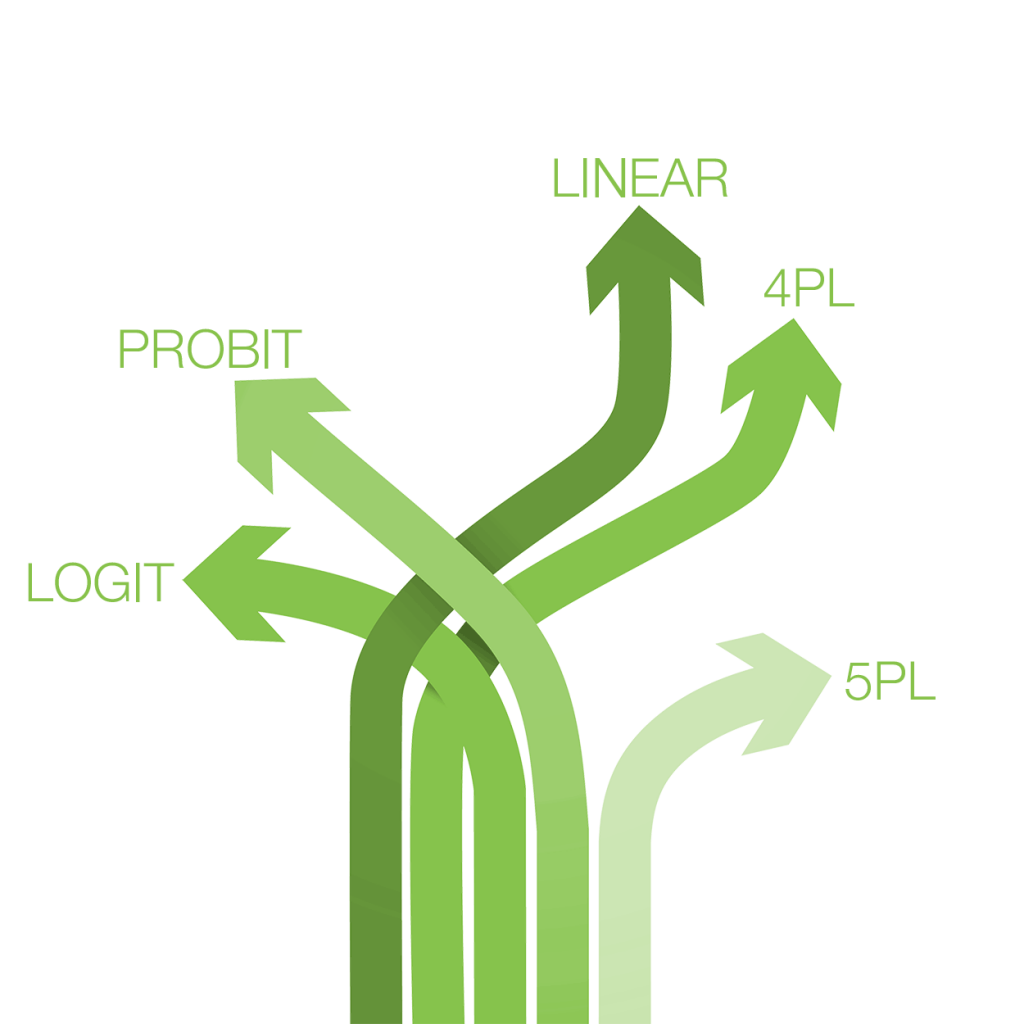
For a traditional ELISA, a quadratic model is usually the model of choice for analysis; however, the curve fit should always be checked before generating results. Common models for continuous response (e.g. optical density) include a linear model, the 4PL, and the 5PL.These models are suitable for cell-based ELISAs with a relative potency measure.
Variability and ELISA DoE
Any assay that measures either a biologic drug or a drug in a biological system can be highly variable. This variability impacts the response and hence the precision of the reportable value. Quantics can help you understand the contributions of the various factors to the overall variability, in order to design an assay that will meet all regulatory requirements.
The variability inherent in ELISA assays (both traditional and cell-based) arises from a range of sources. Discovering and controlling the important ones can be made much more efficient using a formal Design of Experiments (DoE) approach which provides statistically efficient analysis of the data, optimising the speed of development and minimising resource and costs. In some situations simulation can be used to reduce the laboratory work required.
Instead of studying one factor at a time, these techniques provide an efficient multi-factor approach that generally results in fewer experiments to achieve optimisation. It also provides insight into interactions of factors that affect ELISA performance which can help in further development or validation.
Interpolation Analysis
Support for interpolation analysis in ELISA development, including the Bursa-Yellowlees method.
Statistical Model Choice
Help choosing the optimal statistical model for your assay.
ELISA Variability & DoE
Design of Experiments support to manage assay variability.
Dose Group Optimisation
Simulation studies to optimise dilution group designs.
ELISA Validation
Support for validation of ELISA methods and reporting.
Trend Analysis
Ongoing monitoring and statistical process control support.
Parallelism Testing
Parallelism testing is important in both Interpolation Analysis and RP analysis as it is the primary way of confirming that the unknown is behaving biologically like the reference (and thus the reference is appropriate). In the standard Interpolation Analysis method, the %CV around the dose adjusted results from 2 or more dilutions is a surrogate measure of parallelism. If the dose adjusted results are very different, this suggests non-parallelism. In the RP analysis parallelism can be tested specifically in a number of ways.
Project Insight
Ongoing Monitoring and Statistical Process Control
It is important to monitor the performance of an assay over time. Quantics can help you to implement a monitoring protocol for your ELISA. Simple monitoring by plotting data over time may be adequate in development situations, but in GMP manufacturing regulators are starting to expect a more formal approach known as statistical process control (SPC). This methodology typically charts suitable parameters of the Reference Standard response curve and QC samples or test samples, and has a number of statistically derived rules that trigger warring or action alarms if the assay is showing signs of shifting or drifting. SPC control limits are set based on an analysis of historical data, and Quantics can help you to implement a suitable SPC monitoring protocol for your ELISA.