
Statistics for Bioassays
Quantics has more than 20 years of experience helping our clients achieve their goals. Get in touch to find out how we can help you develop and optimise your next bioassay.
Bioassay Development
Involving appropriate statistical support from the early stages of bioassay development can help to ensure a linear development pathway by optimising the experimental designs and thus minimising repeated work. Mathematical simulation can replace the need for some laboratory work altogether. The combination can save considerable time and expense over the course of a bioassay development process from bench to product.
Relative Potency
With small molecule chemical drugs the potency is fairly well related to how much drug is in the preparation, and that can be measured with good accuracy. With a biologic, the potency is related not so much to the amount of stuff in the preparation, but to the biological activity of the preparation, and that has to be measured in a biological system (a bioassay) that is itself variable.
Parallelism Testing
Parallelism testing is a crucial regulatory requirement. Choosing the wrong test or setting the pass fail criteria incorrectly may result in unnecessary assay failures. Quantics can advise on the best method to ensure the suitability of your samples while minimising unnecessary failures.

Project Insight
A major pharmaceutical manufacturer had been running a bioassay for GMP batch release for some years without formal parallelism testing. The FDA had warned them that the method would need updating. Quantics was instrumental in:
- The development of a new analysis method that included formal parallelism testing
- Optimising the experimental design to reduce significantly the laboratory costs
- Establishing new system and sample suitability criteria for the new process
- Formally validating the new process
- Documenting all the analysis changes for FDA submission
The subsequent FDA submission was successful, allowing the company to continue production of the biologic.
Statistical Model Choice
Quantics have years of experience to help you choose the optimal statistical model. We can advise on data transforms, outlier management and management of LOQ values to ensure the model fits the data well and is stable to data variability. The statistical model has a major impact on assay accuracy, sensitivity, reliability, and cost. Some models are more likely to fail a test item if the RP is low, or the data are highly variable.
Common models for a continuous response are:
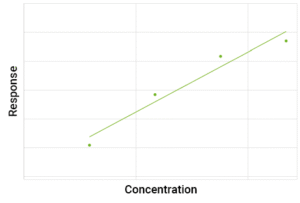
Linear Model
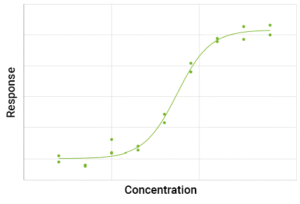
4 Parameter Logistic (4PL)

5 Parameter Logistic (5PL)
Common models for quantal/binary response bioassays are:
Logit
Probit
Bioassay Optimisation
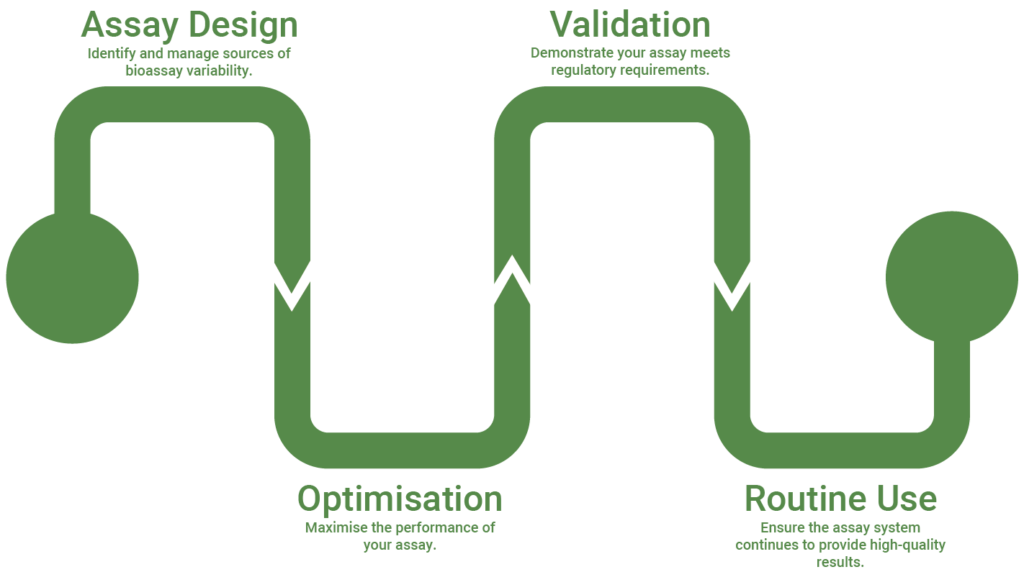
In bioassay development, the final method is normally locked when adequate precision and accuracy have been achieved, formally documented as part of the statistical validation step. Once validation is complete, the assay may remain in use in the same format for many years. During development, assays often evolve in a complex way. In the hunt for acceptable accuracy and precision many different designs are tried out, and there are many choices to be made. Once the biology is stable and well characterized, it is time to re-evaluate the design – think about optimising your assay before validation. Stop, step back and review whether all the elements of your design are actually required before continuing.
Dose Group Optimisation
In Bioassay dose groups and required replicates are typically determined by experimentation. Quantics can save you time and experimental costs by using simulation studies to determine the design that will optimise assay performance. Simulation can explore the impact of dose group spread and distribution, numbers of replicates, and for in vivo studies, this may include unequal numbers of animals in the dose groups.
Variability and DoE in Bioassays
Bioassays can be very variable, which impacts the response and hence the precision of the reportable value. Quantics can help you understand the contributions of the various factors to the overall variability, in order to design an assay with the required performance.
The variability inherent in bioassays arises from a range of sources. Discovering and controlling the important ones can be made much more efficient using a formal Design of Experiments (DoE) approach which provides statistically efficient analysis of the data, optimising the speed of development and minimising resource and costs. In some situations, simulation can be used to reduce the laboratory work required. Instead of studying one factor at a time, these techniques provide an efficient multi-factor approach that generally requires fewer experiments to achieve optimisation, and also provide insight into interactions of factors that affect bioassay performance.
Project Insight
Bioassay Validation & Routine Use
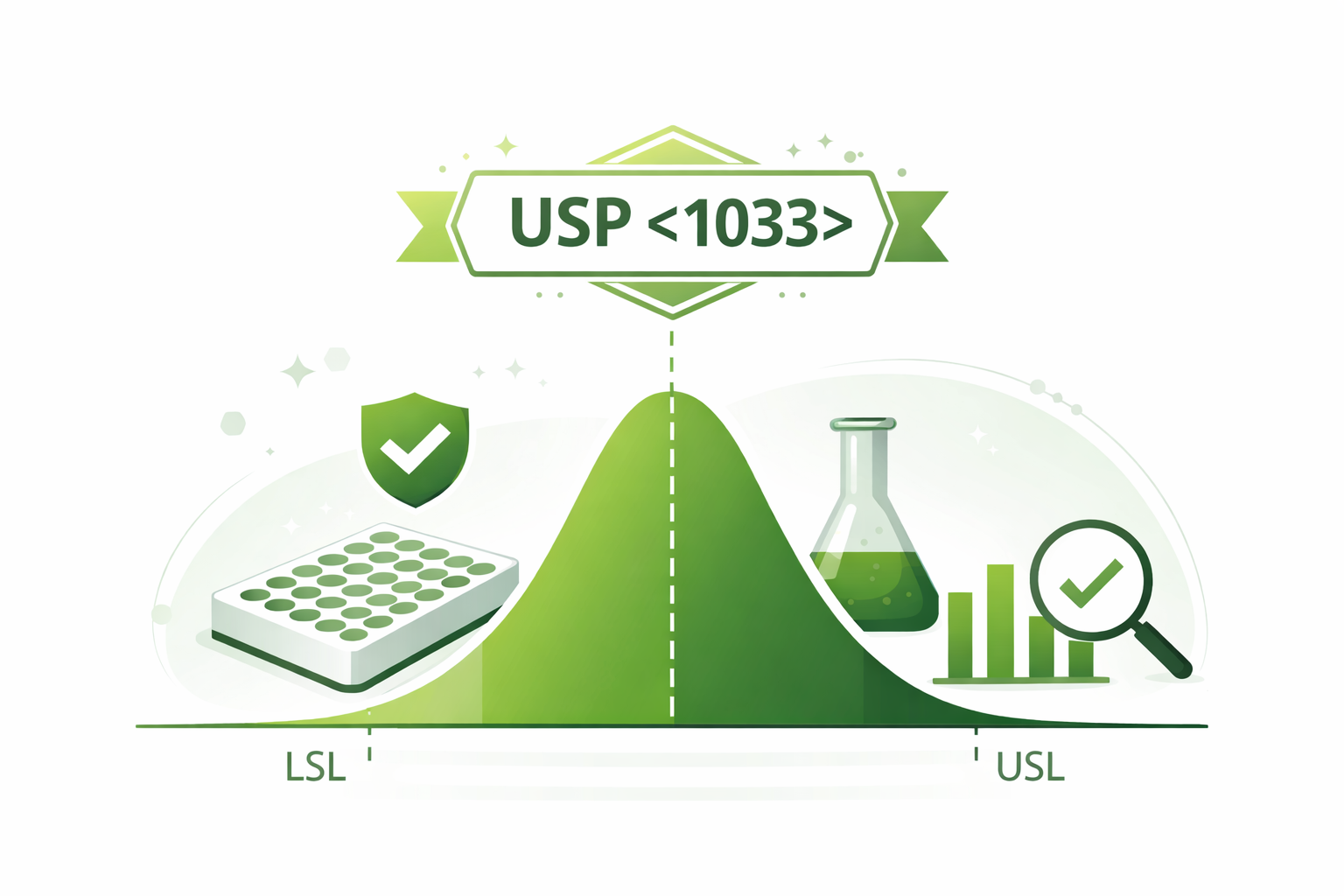
Quantics can help ensure that your assay validation study follows the appropriate regulatory guidance in all its statistical aspects, both design and analysis. Assay validation is the process of demonstrating and documenting that the performance characteristics of the procedure and its underlying method meet the requirements for the intended application and that the assay is thereby suitable for its intended use. For bioassays, USP general chapter Biological Assay Validation <1033> and ICH Q2(R1) should be followed.
Method Comparison
Quantics can perform method comparison studies, which are required when a change is made that affects an analytical method – e.g., a bridging study for a change in reference material, a transfer study for a change in test site – or when there are multiple analytical methods for evaluating the same characteristic of the product. In the case of the latter, a method comparison study may be performed to determine whether the methods are sufficiently similar.
Reference Bridging and Method Transfer
Bridging and transfer studies aim to demonstrate that an old and new method (or laboratory location) have equivalent performance. A number of factors may have to be considered including defining the important characteristics to equate for accuracy and precision. Quantics can help design bridging studies to include types and numbers of samples, lots / runs required, and the establishment of acceptance criteria. Several statistical approaches are available and Quantics will advise on the best approach for the particular circumstances taking into account known regulator preferences. All work can be carried out to GMP.
Ongoing Monitoring and Statistical Process Control
It is important to monitor the performance of an assay over time. Quantics can help you to implement a monitoring protocol for your bioassay. Simple monitoring by plotting data over time may be adequate in development situations, but in GMP manufacturing regulators are starting to expect a more formal approach known as statistical process control (SPC).
This methodology typically charts suitable parameters of the Reference Standard response curve and QC samples or test samples, and has a number of statistically derived rules that trigger warning or action alarms if the assay is showing signs of shifting or drifting. SPC control limits are set based on an analysis of historical data, and Quantics can help you to implement a suitable SPC monitoring protocol for your bioassay.
Statistical Review
We understand that statistics can be difficult, particularly in the highly variable and complex world of bioassay. That’s why we offer the opportunity for our team of expert statisticians to check statistical methods to ensure they are fit for purpose.
Quantics can provide a completely independent review of your study protocols to address any statistical concerns:
Is the Study Design Appropriate?
Is the Protocol Well-Specified?
Does Analysis follow Guidances?
Read our blog.
Explore insights across the world of biostatistics, from the complexities of bioassay optimisation to the practicalities of sample size calculations. Subscribe to receive the latest technical insights and thought leadership from the Quantics team.